


Ah, Ross and Rachel. Everyone knows the deal—they “had been on a damage!” It’s a relentless loop of the drama triangle that may make even essentially the most seasoned cleaning soap opera celebrity roll their eyes.
Ross, feeling disregarded and jealous, will get clingy. Rachel apologizing for short of to concentrate on her profession. Despite the fact that she hasn’t executed anything else mistaken, he will get dissatisfied, blaming her. When she breaks up with him, he sleeps with somebody else, and the cycle repeats: guilt, jealousy, and blame—neither of them in a position to break away.
In reality, this type of damaging back-and-forth doesn’t simply occur in TV displays or films. It’s a trend all of us fall into—whether or not we acknowledge it or no longer.
“The issue,” as courting therapist Dr. Laura Berman issues out in her Quantum Love: The Blueprint for Ordinary Relationships program on Mindvalley, “is that the majority folks spend greater than part of our time at the triangle and don’t even understand that we’re on it.”
However working out why it occurs is step one towards transferring the narrative.
What’s the drama triangle?
The drama triangle is a mental idea that explains the jobs we occasionally fall into when issues get messy or demanding. Created through psychiatrist Stephen Karpman, it displays how we will get caught in dangerous patterns of habits with people.
However Dr. Berman tailored this concept for relationships and switched issues up slightly. (Whilst the Karpman drama triangle is victim-rescuer-persecutor, her model is victim-villain-hero.) It’s the similar elementary thought, however with a twist that’s extra suited for the ups and downs of romantic dynamics:
- The sufferer is the one who feels helpless and incessantly has low vanity. They consider they’ve were given no keep watch over over issues and have a tendency to stay up for somebody to swoop in and save the day.
- The villain criticizes, judges, and controls, incessantly making others really feel dangerous or accountable. Recall to mind the individual all the time pointing arms and not taking accountability for his or her movements.
- The hero needs to assist and save the sufferer, incessantly at the price of their very own wishes. They may really feel nice about their just right deeds, however their makes an attempt to assist don’t all the time clear up anything else—and occasionally they only make issues worse.
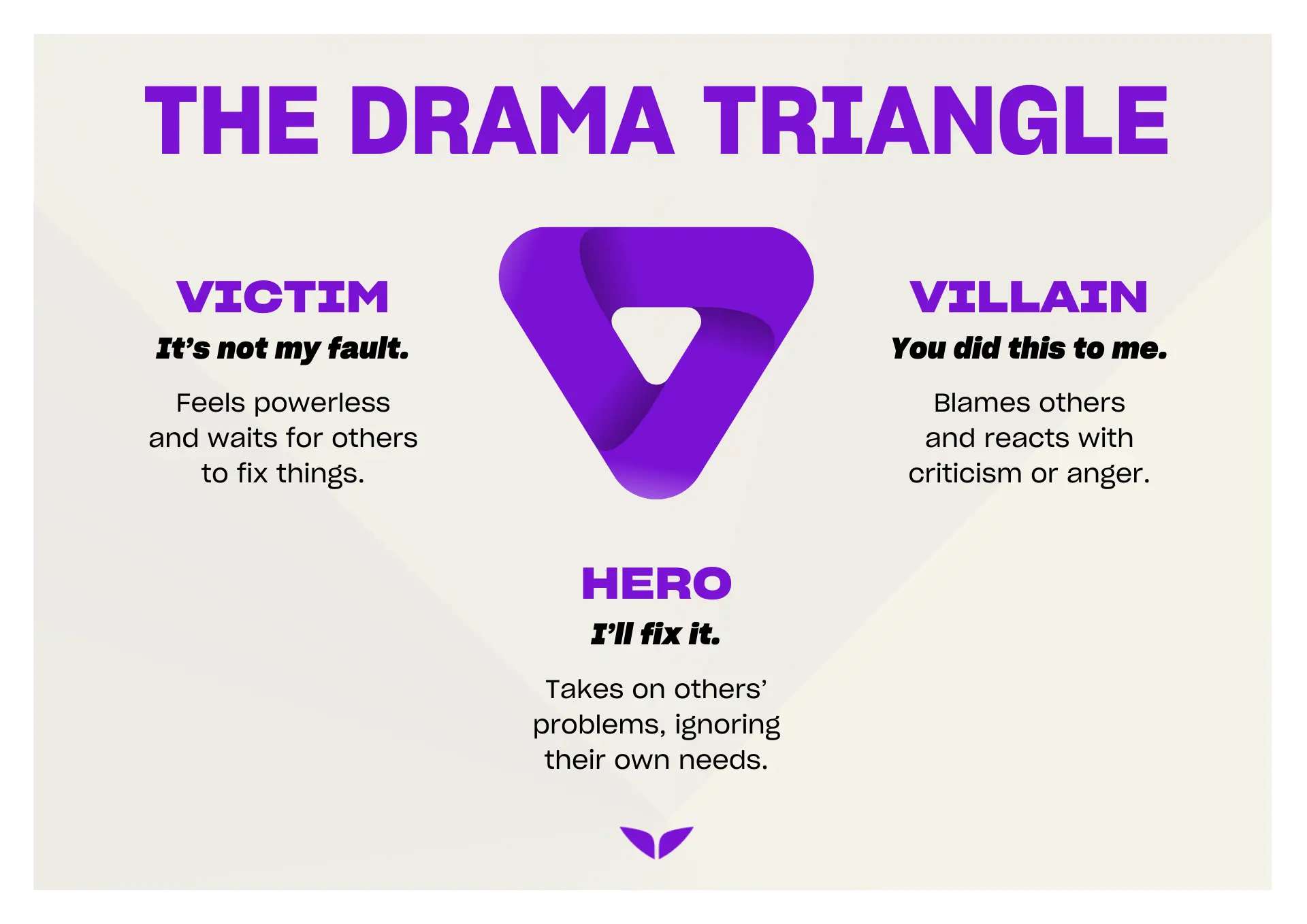
The article is, the drama triangle is slightly of a lure. You’ll get caught in those roles, and the cycle simply assists in keeping repeating itself.
The issue is that the majority folks spend greater than part of our time at the triangle and don’t even understand that we’re on it.
— Dr. Laura Berman, instructor of Mindvalley’s Quantum Love: The Blueprint for Ordinary Relationships program
The rescuer may get bored to death and turn out to be the persecutor, blaming the sufferer for no longer appreciating their assist. Or the sufferer may snap and get started blaming everybody else, even the one who used to be seeking to assist them within the first position.
“We slip into those roles every now and then, incessantly even combining a few roles without delay, like sufferer and villain on the identical time,” says Dr. Berman.
She provides that we incessantly to find ourselves slipping into our most well-liked roles, particularly after we’re brought about or all over a heated argument. We don’t all the time understand it, however the fact is, it may occur at any time.
The way you fall into the drama triangle
Entering those dangerous courting patterns incessantly begins with previous trauma or realized behaviors from early life. Right here’s a have a look at each and every position and the way you could lift that luggage into your grownup relationships:
The sufferer
Dr. Virginia Marie Love (higher referred to as Dr. Gin), an intuitive psychotherapist and courting and trauma specialist, explains that those that are overly codependent are merchandise of “a circle of relatives atmosphere that used to be ensconced in drama, which changed into the hard-wired programming they now paintings thru lifestyles making an attempt to unravel.” Actually, one learn about discovered that this trust in unworthiness can push an individual into the sufferer position.
Right here’s an instance: A person who didn’t have a worrying mother rising up may finally end up with a lady who acts extra like a caretaker than a spouse. She fills the will for the nurturing he ignored, nevertheless it’s in an unbalanced method.
The villain
Folks fall into this position after they really feel prone or insecure, and as an alternative of addressing the ones feelings at once, they lash out. Dr. Berman describes them as “usually vital, has a tendency to be sarcastic, and incessantly issues the finger of blame.”
As an example, a pair is past due to a cocktail party on account of surprising visitors. The person, feeling annoyed, blames the girl, announcing, “You must’ve recognized this could occur.” As a substitute of accepting the location is out in their keep watch over, he is going out of his window of tolerance and lashes out. The blame is going to her as he refuses to concentrate when she tries to provide an explanation for.
That’s the item with villains—as an alternative of unveiling vulnerability or expressing their very own harm, they deflect their very own concern or lack of confidence through changing into antagonistic and blaming others.
The hero
“The hero feels liable for everybody else’s happiness,” explains Dr. Berman, “and is keen to do no matter it takes to make others really feel relaxed at any price.”
She is going on to provide an explanation for that folks on this position act out of a way of ego and low-frequency power. They usually consider they will have to all the time “save” others to really feel valued.
This can result in a cycle of codependency, the place the hero is so excited by assembly others’ wishes—whether or not at house or at paintings—that they fail to remember to care for themselves. And this will purpose psychological load and make them burn out.
Drama triangle examples
Ross and Rachel’s dynamic could also be a quintessential instance of the drama triangle. However how may just it play out in actual lifestyles?
Listed below are some not unusual cases:
Mother or father and teen
Your teenager feels misunderstood and retreats to their room, slipping into the sufferer position. Folks on this position incessantly really feel helpless and might specific passive-aggressive habits. For instance, your teenager may say, “I don’t care” when requested about dinner, most effective to really feel dissatisfied later whilst you (or your spouse) don’t pick out their favourite eating place.
Because the father or mother, you wish to have to mend the location, so that you step in to “rescue” them, providing recommendation or seeking to clear up the issue. However as an alternative of appreciating your assist, your teenager pulls away, rising extra green with envy.
This frustration ultimately leads you to turn out to be the villain and criticize their habits.
Administrative center drama
You’re repeatedly being criticized through your supervisor for ignored points in time, which leaves you feeling helpless and unappreciated. Whilst you’re on this sufferer position, you incessantly really feel just like the accountability on your lifestyles is from your arms and also you stay up for somebody else to step in and make issues proper.
Your coworker, short of to be the hero, steps in to hide for you, staying past due to complete your duties. However as an alternative of being thankful, your supervisor errors this as weaponized incompetence and criticizes either one of you, changing into the villain of the tale.
This makes you’re feeling accountable for desiring assist within the first position, reinforcing your sense of helplessness and frustration.
Friendship fallout
You’re feeling such as you’re all the time giving extra to the friendship, however finally, you’re feeling tired and disregarded. As a sufferer, you’re much more likely to interpret even innocuous gestures as hidden insults or consider that your pal is truly a covert narcissist.
They, short of to make issues proper, attempt to overcompensate through providing items or making further efforts to turn they care (as any hero would do). Then again, as an alternative of constructing issues really feel higher, it simply finally ends up feeling awkward and insincere.
Ultimately, feeling unappreciated, you get annoyed. The villain in you comes out and also you get started blaming them for being too difficult.
Romantic courting
You begin to really feel insecure on your courting, wondering whether or not your spouse is actually invested or in the event that they care sufficient. On this second, you slip into the sufferer position, feeling prone and depending in your spouse to raise you up and make the whole thing higher.
Your spouse tries to reassure you. Because the hero, they bathe you with items and a focus. However as an alternative of feeling comforted, you close them out.
This most effective frustrates your spouse, who now doesn’t understand how to reply to your stonewalling. They turn out to be the villain and get started blaming you on your habits.
This most effective makes you’re feeling much more accountable for desiring their reassurance.
Social media drama
You’re scrolling thru your feed, feeling unnoticed as your pals percentage their glad moments. As you have a look at their posts, you get started wishing it’s worthwhile to be a part of the ones moments however feeling like a sufferer who’s powerless to switch your scenario.
A chum notices your silence and comes to a decision to succeed in out, sending a message or suggesting plans to hang around. They take at the hero position, seeking to raise your spirits, however as an alternative of feeling reassured, you begin to query their intentions, questioning in the event that they’re most effective doing it to look worrying.
Ultimately, your frustration builds, and also you start to accuse them of most effective checking in as a result of they really feel obligated. This shift pushes your pal into the villain position, as they begin blaming you for being ungrateful and making them really feel like their kindness used to be wasted.
Spotting the drama triangle on your lifestyles
Within the warmth of an issue or when feelings are working top, it may be a large number of “he stated, she stated.”
Dr. Gin provides that breaking the cycle is through “taking duty on your personal behaviors and obviously pointing out for your spouse what your wishes are emotionally.”
However how are you able to inform? There are transparent indicators you’ll be able to glance out for:
- You understand that you simply repeatedly really feel such as you’re the only being wronged or that not anything ever is going your method. This incessantly comes with the concept, “If most effective they’d do that, or act that method, the whole thing can be wonderful.”
- You catch your self pointing arms and blaming others for what’s mistaken within the scenario. On this scenario, you’re completely satisfied the opposite particular person is liable for the issue, and you may even begin to gaslight or criticize them in an try to regain keep watch over.
- You’re feeling liable for solving everybody’s issues or to find your self bending over backward to make others glad (even at the price of your personal wishes).
- You’re feeling completely sure that you simply’re in the best and the opposite particular person is within the mistaken. That is whilst you’re working from a spot of ego and it assists in keeping you at the drama triangle loop.
- You end up overreacting emotionally to one thing minor. On this second, you may really feel beaten or caught, like not anything you do will alternate the location. That is when the drama triangle incessantly takes hang, resulting in defensiveness, anger, or helplessness.
The secret’s, breaking loose truly begins with self-awareness. The instant you understand the jobs and triggers, you regain the facility to step out of the cycle.

How one can get out of the drama triangle
Should you’ve ever been caught in a whirlwind of drama, you understand how hard it may really feel. However nobody’s caught on this poisonous cycle in the event that they don’t need to be there.
There are some forged drama triangle answers that permit you to prevent the insanity. Listed below are some steps you’ll be able to take:
1. Take accountability on your position
It’s simple to fall into the blame recreation, however in the event you do, you’ll by no means get off that experience. So Dr. Berman advises to “all the time attempt to take your personal 100%.”
Take Ross and Rachel, as an example. As a substitute of spotting his personal emotions of lack of confidence or jealousy, Ross blames her for no longer worrying about him or their courting. And Rachel? Sufferer mentality till she not may just take his consistent whining and jealousy. Then, the jobs transfer, and he or she turns into the villain whilst he harps at the “We had been on a damage!” excuse.
A more healthy dynamic can be for either one of them to come clean with their feelings. Ross may just admit that he’s jealous of Mark. Rachel may just specific her want for house and independence.
When each companions prevent blaming each and every different and get started proudly owning their 100%, they are able to break away from the cycle and create a extra balanced courting.
2. Perceive your emotional triggers
Emotional triggers incessantly result in an automated response. Like when Ross sees Rachel’s coworker, Mark, his jealousy flares up. Or when Rachel sees Ross with Bonnie, she convinces her to shave her head.
Those triggers come from emotions we haven’t absolutely handled but. They remind us of previous reviews, most often from early life, the place we felt harm, prone, or unimportant.
How are we able to deal with them? Dr. Berman encourages us to invite, “Why is that this resonating with me on this method? What’s my response telling me about me?”
Whilst you perceive what’s triggering your feelings, you’ll be able to prevent reacting from a spot of defensiveness or frustration and maintain the location with extra self-awareness and self-compassion.
3. Discuss unarguably
Arguably? No doubt you’ve heard of it. However unarguably? What does that even imply?
“Whilst you’re talking unarguably, you’re talking truths that follow most effective to you,” explains Dr. Berman. “So that you’re no longer projecting anything else onto your spouse, nor are you making assumptions or accusations about how they’re considering or feeling.”
As an example, as an alternative of claiming, “You all the time do that,” it’s worthwhile to take a look at announcing, “I think harm when this occurs.” This manner, you’re sharing your personal feelings and viewpoint with out attacking. And this takes the facility out of the argument and assists in keeping issues from escalating right into a Ross and Rachel breakup-type drama.
4. Admire limitations and desires
Have you ever ever questioned how Ross and Rachel would’ve became out if he simply revered her limitations and desires? Or if she may just’ve simply stated how she felt as an alternative of unveiling up at Ross’s marriage ceremony to Emily?
“Your spouse can’t make stronger your individual construction and expansion until you permit them to understand the perception of figuring out the place nurture is maximum really helpful,” explains Dr. Gin. Analysis has additionally discovered that respecting limitations in relationships ends up in upper delight, particularly when each companions are at the identical web page about their roles.
So be fair about what you want together with your spouse. And accomplish that whilst additionally respecting their wishes.
5. Refuse to take part
From time to time, merely no longer attractive within the drama is one of the best ways to get out of the drama.
“This isn’t shutting your spouse out through development a wall of self-pity or changing into overly delicate, emotionally absent, or overly needy,” explains Dr. Gin. Slightly, it’s when you are making the selection to stick grounded and keep away from falling into roles just like the sufferer, villain, or hero.
So when your spouse is on your face, acts helpless, or tries to sort things for you, you step again and say, “I’m no longer going to interact on this presently.”
And it really works highest when each companions decide to this. The connection turns into extra balanced, and the cycle of drama begins to dissolve.
Heal. Upward push. Thrive.
“We had been on a damage!” will have stored Ross and Rachel in an ever-looping drama triangle, however that doesn’t must be your love tale.
With Mindvalley’s methods, together with Dr. Laura Berman’s Quantum Love: The Blueprint for Ordinary Relationships, you’ll be able to break away from the emotional cycles that stay you caught…
…find it irresistible did for Nidhi Sood, a freelancer in India, who discovered “this system’s profound insights have undoubtedly shifted my relationships.”
Join a loose Mindvalley account and get a style of the way aligning your power can change into your love lifestyles—whether or not you’re rekindling a courting or discovering new love. You’ll additionally get get admission to to day by day meditations, sign up for a world group, and keep up to date on Mindvalley occasions.
The truth is, love isn’t a TV sitcom. And with the best equipment, you’ll be able to damage the cycle and create a connection that’s magnetic and actual.
Welcome in.

